
Ielts Writing Task 1 Hướng Dẫn cách viết biểu đồ Process

Ielts Writing Task 1 Hướng Dẫn cách viết biểu đồ Process
Mastering IELTS Writing Task 1: Process

IELTS Writing Task 1

Process Masterclass

1. Tổng Quan Dạng Bài Process

Teacher’s Hook: Process (Quy trình) không có con số để so sánh. Nhiệm vụ cốt lõi của bạn là miêu tả trôi chảy, không sót bước nào từ đầu đến cuối.

Quy trình Tự nhiên

VD: Vòng đời ếch, bướm, tuần hoàn nước…

Dùng câu CHỦ ĐỘNG

The egg hatches into a frog.

Quy trình Sản xuất

VD: Tái chế nhựa, sản xuất điện…

Dùng câu BỊ ĐỘNG

Bottles are crushed by a machine.

2. Vũ khí Ngữ pháp & Từ nối

Bài Process sẽ cực kỳ nhàm chán nếu chỉ dùng “Step 1, Step 2”. Hãy “nâng band” bằng 2 vũ khí dưới đây.

Bảng Từ Nối Ghi Điểm (Most common sequencing languages)

Beginnings
  • Initially / At first
  • To start with / To begin with
  • First of all / Firstly
  • In the beginning
Middles
  • Secondly / thirdly
  • later / then / afterwards
  • at this point / meanwhile
  • next / after that
  • subsequently / later on
  • during this time
Endings
  • Finally
  • Eventually
  • In time
  • In the end
  • Ultimately
  • Lastly
[The first stage]
  • The first stage is when S + V
  • To begin with,
  • The process commences with
  • Initially,
[The middle stage]
  • This step involves + ing
  • After this stage is complete,
  • The next step is when S + V / By this stage,
  • The step after this, / At this point,
  • At the same time, / Meanwhile,
  • Simultaneously, / Alternatively,
  • While / As
  • Once A has finished, B is able to start
[Express purpose]
  • A is done (so as) to produce B
  • A is done in order that B can be
  • So that / In order that
[Cause and Result]
  • A result in B
  • A lead to B
  • A cause B
[The last stage]
  • Once the final stage has been completed,
  • Finally,
  • Eventually,
  • Ultimately,
Cụm từ chỉ thời gian khác (Extra)
After a long time At last At that time At the beginning After a while At the end Concurrently Following that In the meantime On the next occasion Prior to Sequentially

Drill Khởi động: Phản xạ Từ nối

Gõ đáp án tiếng Anh và nhấn Enter để kiểm tra. Sai sẽ hiện đỏ (tự xóa sau 1.5s), đúng hiện xanh.

Interactive

Drill 1: Phản xạ Câu Bị Động (15 câu)

Manufacturing Process

Chuyển đổi các câu chủ động sang Bị động Hiện tại đơn (is/are + V3).

Drill 2: Gộp câu bằng Từ nối Phức (15 câu)

Band 7.0+ Skill

Sử dụng từ gợi ý để nối câu. Chú ý cấu trúc: After / Before + BEING + V3.

3. Cấu trúc 3 Bước & Luyện viết

1

Introduction (Mở bài)

Công thức vàng: The diagram illustrates + the process of [V-ing] / how [N] is produced.

Drill 3: Paraphrase Đề Bài (10 câu)

Hệ thống sẽ chấm điểm nếu câu bạn gõ chứa các từ khóa chính. Hãy đối chiếu câu trả lời hoàn chỉnh nhé.

2

Overview (Tổng quan)

Chiến thuật: Hãy đa dạng hóa cấu trúc (comprises, multi-step process, undergoes…) thay vì chỉ dùng “Overall, there are…” để gây ấn tượng với giám khảo.

Drill 4: Viết câu Overview Đa dạng Cấu trúc (21 câu)

3

Body Paragraphs (Thân bài)

Tuyệt chiêu Nối Câu (Sentence Combining)

  • 1. Dùng WHICH:Beans are put into a machine, which then dries them.
  • 2. Dùng IN ORDER TO:Clay is moulded in order to shape it into bricks.
  • 3. Dùng WHERE:Goods are transported to a shop, where they are sold.

Drill 5: Nâng cấp câu Thân bài hoàn chỉnh (12 câu)

4. Thực Chiến Đề Thi Thật

Áp dụng toàn bộ kiến thức để giải quyết kho đề thi thật. Tuyệt chiêu: Tận dụng tối đa từ vựng (danh từ, động từ) có sẵn trên hình!

Phần 1: Ngân hàng Đề thi thật

Đề Mới 1: Mosquito Life Cycle

“The diagram below shows the life cycle of the female mosquito.”

Đề Mới 2: Electricity Production

“The diagram below shows the process of electricity production.”

Đề Mới 3: Olive Oil Grades

“The diagram shows the manufacturing process of olive oil of different grades.”

Đề Mới 4: Solar Drinking Water

“The process below shows how drinking water is made using solar power.”

Đề Mới 5: Aluminium Cans

“The diagram below shows the stages in the recycling of aluminium drinks cans.”

Đề Mới 6: Pineapple Products

“The diagram shows the process of growing and preparing pineapple and pineapple products.”

Đề Mới 7: Manufacturing Process

“The diagram illustrates a manufacturing process.”
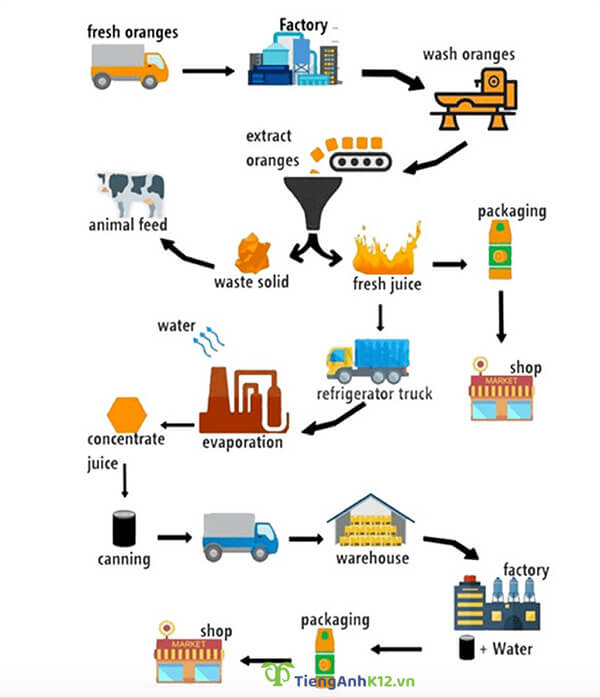
Đề Cũ 1: Orange Juice

“The diagram below shows how orange juice is produced.”
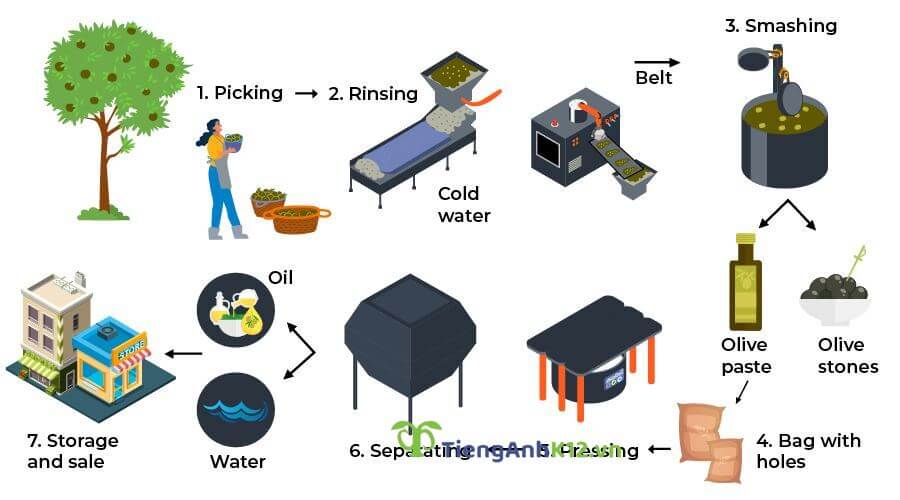
Đề Cũ 2: Olive Oil

“The diagram below shows the production of olive oil.”
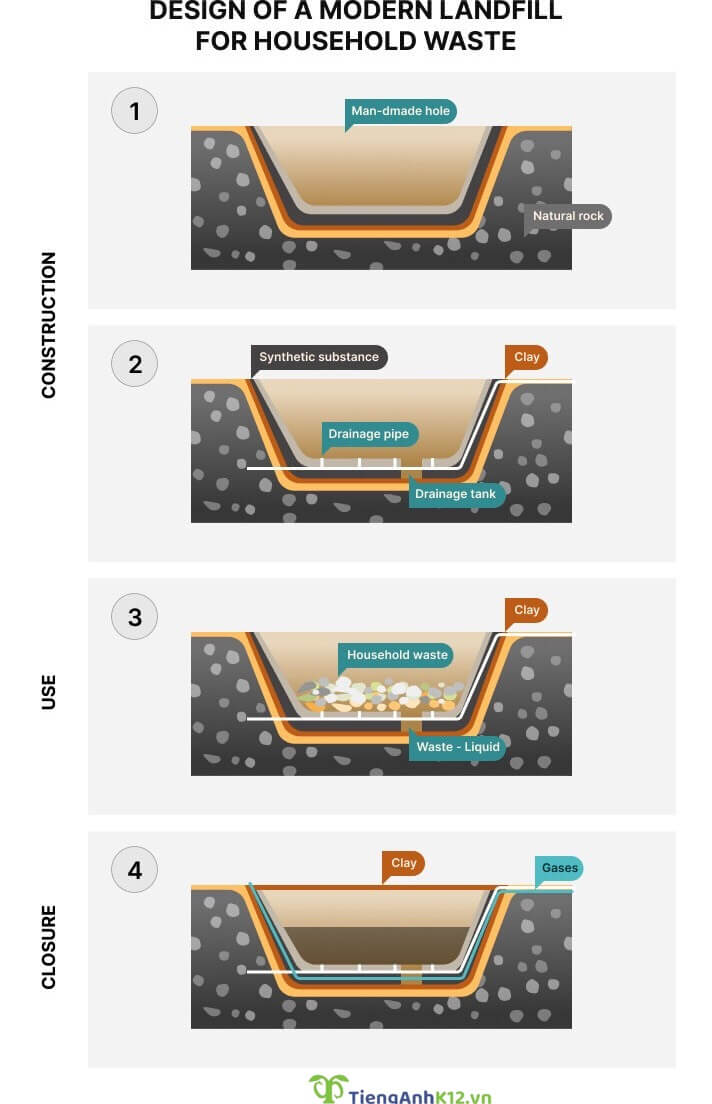
Đề Cũ 3: Modern Landfill

“The diagram shows the design of a modern landfill for household waste.”
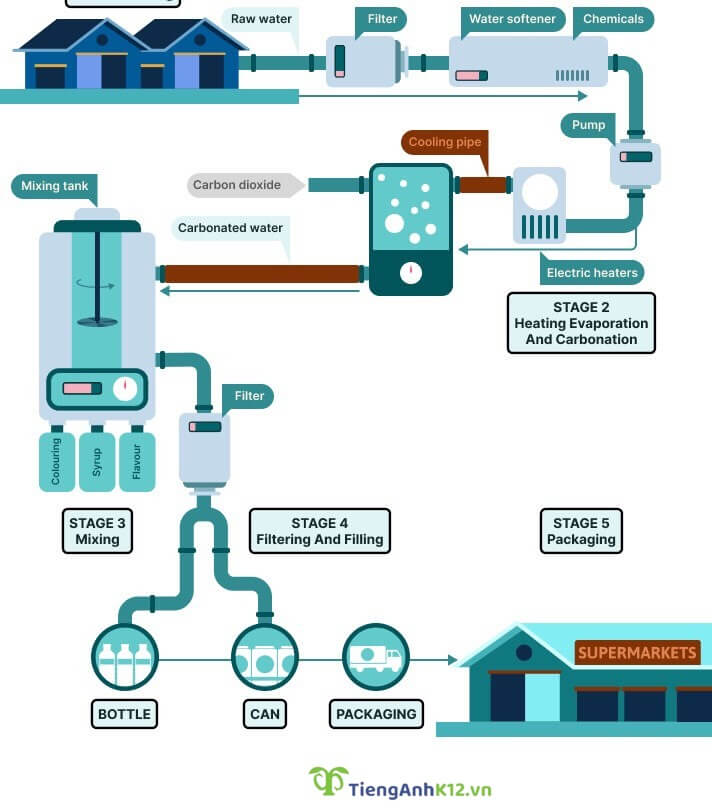
Đề Cũ 4: Carbonated Drinks

“The diagram gives information about the process of making carbonated drinks.”
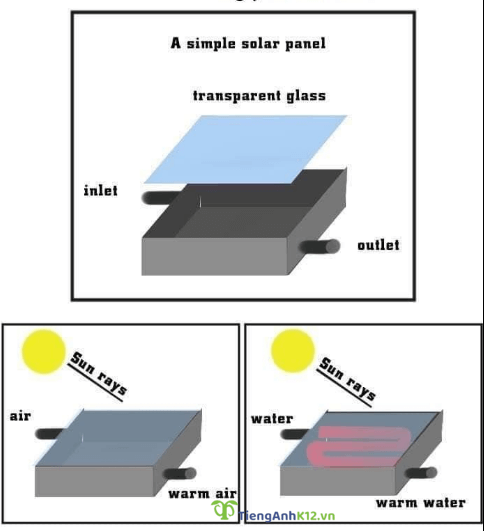
Đề Cũ 5: Solar Panel

“The diagram shows the structure of the solar panel and its use.”
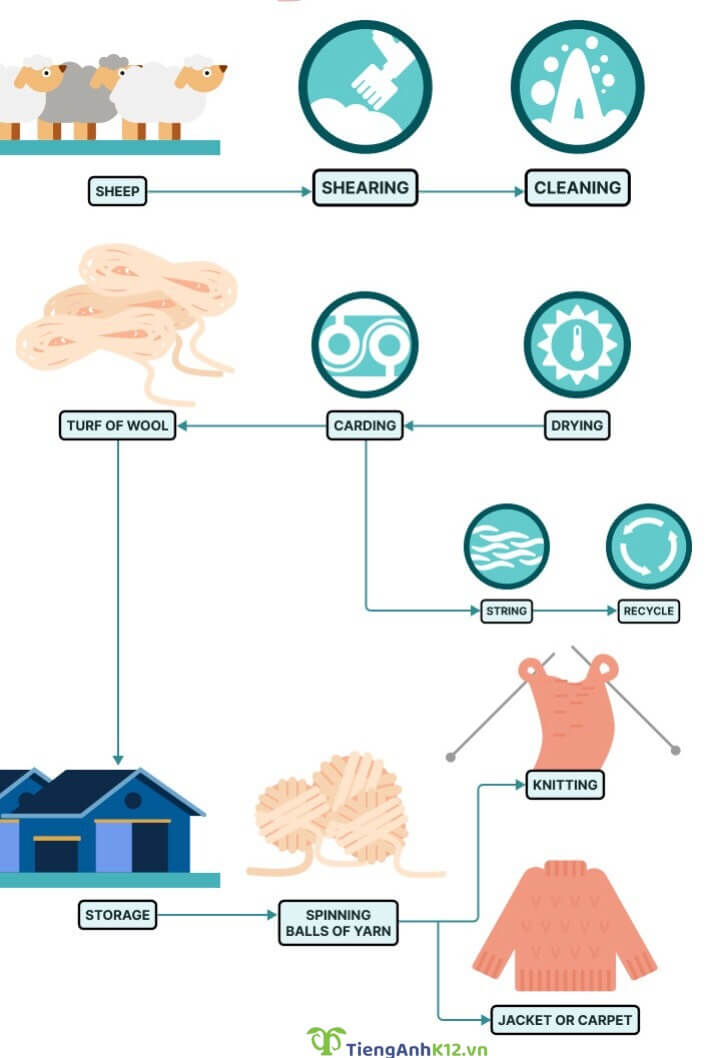
Đề Cũ 6: Making Wool

“The picture shows the process of making wool.”
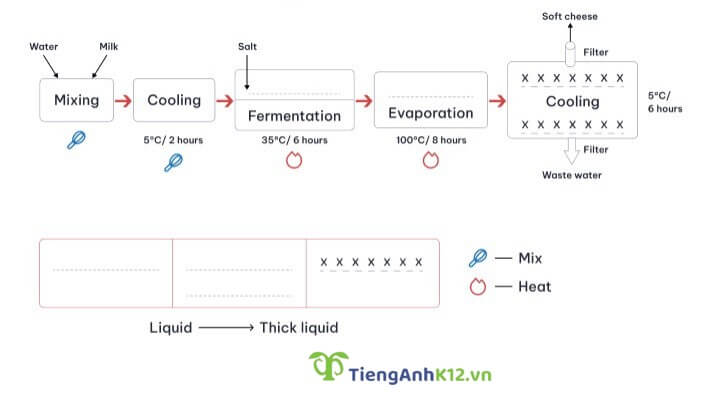
Đề Cũ 7: Soft Cheese

“The diagram below shows the process of making soft cheese.”

Phần 2: Hướng dẫn Phân tích & Thực hành Viết

Với mỗi đề, bạn hãy xem dàn ý, tự gõ bài viết của mình vào khu vực thực hành, sau đó mới xem bài mẫu Band 6.5 để đối chiếu.

Đề Mới 1: Mosquito Life Cycle (Natural Process)
Mosquito Life Cycle

Bước 1: Lấy từ vựng & Ráp câu CHỦ ĐỘNG

  • EggsMosquito lays eggs
  • Larva / HatchEggs hatch into larvae
  • Pupa / EmergeTransform into pupa, emerge as adult

Bước 2: Lên Dàn ý & Thực hành Viết

Intro & Overview: Viết lại đề “The diagram shows the life cycle of the female mosquito.” Có 4 giai đoạn chính từ trứng đến muỗi trưởng thành.
Body 1: Giai đoạn đẻ trứng (lays eggs) trên nước → nở thành ấu trùng (hatch into larvae) → thở ngược.
Body 2: Ấu trùng biến thành nhộng (pupa) → Muỗi trưởng thành chui ra (emerges) & bay đi.

Bước 3: Đối chiếu Bài mẫu Band 6.5

Từ trên hình Cấu trúc/Từ nối Từ vựng thêm

The diagram illustrates the life cycle of the female mosquito. Overall, there are four main stages in this natural process, starting with eggs and ending with the adult insect.

First of all, the female mosquito lays eggs on the surface of the water. After a few days, these eggs hatch into larvae. At this stage, the larvae live in the water and hang upside down to breathe.

Next, the larvae transform into pupae. They stay in this form for a short time before fully developing. Finally, an adult mosquito emerges from the pupa. It flies away to find food, and the life cycle begins again when the female lays new eggs.

Đề Mới 2: Electricity Production
Electricity Production

Bước 1: Lấy từ vựng & Ráp câu bị động

  • Coal / Mineis mined
  • Crushis crushed
  • Heat / Steamis heated
  • Turbine / Generatorturns the turbine

Bước 2: Lên Dàn ý & Thực hành Viết

Intro & Overview: Viết lại đề “The diagram shows the process of electricity production.” Từ than đá đến nhà dân.
Body 1: Đào than (mined) → nghiền nát (crushed) → làm nóng (heated) tạo hơi nước (steam).
Body 2: Hơi nước quay turbine → máy phát (generator) → chuyển điện (grid/homes).

Bước 3: Đối chiếu Bài mẫu Band 6.5

The diagram shows the process of electricity production using coal. Overall, it is a multi-step process, beginning with mining and ending with supplying power to homes.

To begin with, coal is mined from the ground and transported to a facility. Here, it is crushed into small pieces by a machine. After being crushed, the coal is heated in a large furnace.

This heating process produces steam. Subsequently, the steam flows through pipes and turns a turbine. The turbine is connected to a generator, which produces the electricity. Finally, this electricity is sent through power lines to hospitals, schools, and houses for people to use.

Đề Mới 3: Olive Oil Grades
Olive Oil Grades

Bước 1: Lấy từ vựng & Ráp câu bị động

  • Crushare crushed
  • Cold-pressis cold-pressed
  • Refineis refined

Bước 2: Lên Dàn ý & Thực hành Viết

Intro & Overview: Quá trình sản xuất olive oil nhiều cấp độ. Từ thu hoạch đến đóng gói.
Body 1: Thu hoạch → rửa sạch → nghiền (crushed) thành bột nhão.
Body 2: Ép lạnh (cold-pressed) → Virgin oil. Ép tinh chế (refined) → Regular olive oil.

Bước 3: Đối chiếu Bài mẫu Band 6.5

The diagram illustrates the manufacturing process of olive oil of different grades. Overall, there are several steps, starting with harvesting the olives and ending with packaging different oils for sale.

At the first stage, olives are picked from trees. After being delivered, they are washed in cold water. Next, the clean olives are crushed by a machine to make a paste.

Following this, the paste is cold-pressed to extract the liquid, which is separated into water and oil. The highest quality oil is bottled directly as extra virgin olive oil. Alternatively, some oil undergoes a chemical process where it is refined. Finally, this oil is packaged and sold as regular olive oil.

Đề Mới 4: Solar Drinking Water
Solar Drinking Water

Bước 1: Lấy từ vựng & Ráp câu bị động

  • Solar powerelectricity is generated
  • Pumpwater is pumped
  • Tankis stored in a tank

Bước 2: Lên Dàn ý & Thực hành Viết

Intro & Overview: Viết lại đề “The process below shows how drinking water is made using solar power.”. Từ thu mặt trời đến nhà dân.
Body 1: Solar panel hấp thụ nắng → tạo điện → cấp cho máy bơm (pump).
Body 2: Máy bơm hút nước giếng → vào bồn chứa (tank) → cấp cho nhà.

Bước 3: Đối chiếu Bài mẫu Band 6.5

The diagram shows how drinking water is made using solar power. Overall, this is an eco-friendly system that begins with catching sunlight and ends with providing clean water to houses.

First of all, a solar panel is placed on the ground to catch sunlight. The panel absorbs the sun’s energy and converts it into electricity. This power is then sent to an underground water pump through wires.

Next, the pump uses this electricity to extract water from a deep underground well. After being pumped up, the clean water flows through a pipe into a large storage tank. Finally, the stored water is distributed from the tank to nearby houses, where people can use it for daily drinking.

Đề Mới 5: Aluminium Cans Recycling
Aluminium Cans Recycling

Bước 1: Lấy từ vựng & Ráp câu bị động

  • Collect / Sortare collected / are sorted
  • Shred / Meltare shredded / are melted
  • Roll / Produceare rolled / are produced

Bước 2: Lên Dàn ý & Thực hành Viết

Intro & Overview: Viết lại đề “The diagram below shows the stages in the recycling of aluminium drinks cans.” Gom rác thành lon mới.
Body 1: Bỏ vào thùng rác → thu gom (collected) → phân loại (sorted) → cắt nhỏ (shredded).
Body 2: Nung chảy (melted) → cán phẳng (rolled) → tạo lon mới (new cans) → siêu thị.

Bước 3: Đối chiếu Bài mẫu Band 6.5

The diagram illustrates the stages in the recycling of aluminium drinks cans. Overall, there are several stages, beginning with the collection of used cans and culminating in the production of new ones.

To start with, people throw empty cans into bins. These bins are collected by trucks and taken to a recycling center. At the center, the cans are sorted and cleaned. After being washed, they go through a machine which shreds them into small pieces.

Subsequently, these aluminium pieces are heated in a furnace until they melt. The liquid metal is cooled and rolled into large flat sheets. Finally, these sheets are shaped to make new cans, which are sent back to supermarkets.

Đề Mới 6: Pineapple Products
Pineapple Products

Bước 1: Lấy từ vựng & Ráp câu bị động

  • Plant / Harvestare planted / are harvested
  • Size / Sortare sorted by size
  • Canned / Exportedare canned / are exported

Bước 2: Lên Dàn ý & Thực hành Viết

Intro & Overview: Viết lại đề “The diagram shows the process of growing and preparing pineapple…”. Trồng cây đến 3 loại sản phẩm khác nhau.
Body 1: Trồng crowns → lớn lên → thu hoạch (harvested).
Body 2: Phân loại theo kích cỡ. Nhỏ → làm nước ép (juice). Vừa → đóng hộp (canned). Lớn → xuất khẩu (exported).

Bước 3: Đối chiếu Bài mẫu Band 6.5

The diagram shows the process of growing and preparing pineapple and pineapple products. Overall, it is a multi-step process, starting with planting the fruit and ending with three different products.

Initially, pineapple crowns are planted in the soil. They are left to grow, and after several months, the plants become fully grown. Once they are ripe, the pineapples are harvested and gathered together.

After being collected, the pineapples are washed and sorted into three groups based on their size. The smallest pineapples are sent to a machine which extracts their juice. The medium-sized ones are peeled, sliced, and packaged into cans. Finally, the largest pineapples are washed, packed, and exported as fresh fruit to other places.

Đề Mới 7: Manufacturing Process (Forecast 13)
Manufacturing Process

Bước 1: Lấy từ vựng & Ráp câu bị động

  • Collect / Processare collected / are processed
  • Package / Distributeare packaged / are distributed

Bước 2: Lên Dàn ý & Thực hành Viết

Intro & Overview: Viết lại đề “The diagram illustrates a manufacturing process.” Từ thu gom vật liệu thô đến phân phối.
Body 1: Thu gom nguyên liệu thô (raw materials) → chuyển tới nhà máy → chế biến bằng máy móc.
Body 2: Kiểm tra chất lượng (quality check) → đóng gói vào hộp → vận chuyển đến cửa hàng.

Bước 3: Đối chiếu Bài mẫu Band 6.5

The diagram illustrates a general manufacturing process. Overall, there are several main stages, commencing with the collection of raw materials and finishing with the distribution of the final goods.

To begin with, raw materials are collected. After being harvested, they are loaded onto trucks and transported to a processing plant. At the factory, the materials go into machines, where they are processed and mixed with other things.

Following this processing stage, the items undergo a quality check. The good items are then packaged into boxes. Finally, these boxes are loaded onto delivery vehicles, which distribute them to various retail stores for customers to purchase.

8
Đề Cũ 1: Orange Juice Production
Orange Juice Process

Bước 1: Lấy từ vựng (trên hình) & Ráp câu bị động

  • Fresh orangesSubject
  • Washare washed
  • Extractionis extracted
  • Evaporationis sent to evaporation
  • Cannedis canned
  • Wateris mixed with water

Bước 2: Lên Dàn ý & Thực hành Viết (Guided Practice)

Intro & Overview: Viết lại đề “The diagram shows how orange juice is produced”. Nêu điểm bắt đầu (delivery) và kết thúc (supermarkets). Có thể chia làm 2 loại nước.
Body 1 (Fresh Juice): Từ lúc giao đến nhà máy → rửa sạch → vắt nước. Nhắc đến solid waste làm thức ăn. Gợi ý nối câu: First of all, After being washed, At this stage.
Body 2 (Concentrated Juice): Nước cam chuyển qua lò bốc hơi → đóng hộp → kho chứa → pha nước → siêu thị. Gợi ý nối câu: Alternatively, Here, Next, Finally.

Bước 3: Đối chiếu Bài mẫu Band 6.5

The diagram illustrates how orange juice is produced. Overall, there are two main ways to make the juice, starting with delivery and ending with supermarkets.

First of all, fresh oranges arrive at the factory, where they are washed. After being washed, they go through extraction. At this stage, solid waste is collected in order to make animal feed. The juice can be sent to packaging and sold as fresh juice in supermarkets.

Alternatively, the juice is transferred to evaporation machines. Here, water is removed to make concentrated juice. Next, it goes through canning and is kept in a warehouse. Finally, it is mixed with water again before going to packaging and supermarkets.

9
Đề Cũ 2: Olive Oil Production
Olive Oil Process

Bước 1: Lên Dàn ý & Thực hành Viết

The diagram shows how olive oil is produced. Overall, there are seven steps, beginning with the harvest of olives and ending with sales in bottles.

To begin with, olives are harvested from olive trees. Next, they are washed in cold water. After being washed, the olives go into a machine which smashes them. During this time, olive stones are separated. The olive paste is then put into a bag with holes.

Subsequently, the bags are pressed in a machine in order to get the liquid. This liquid is sent to a centrifuge, where it separates oil and water. Finally, the oil is stored in storage tanks before it is bottled for sales.

10
Đề Cũ 3: Modern Landfill
Landfill Process

Bước 1: Lên Dàn ý & Thực hành Viết

The diagram explains the design of a modern landfill for household waste. Overall, the process has three main phases: construction, usage, and closure.

First of all, a large hole is dug into natural rock. Then, it is lined with clay. Next, synthetic pipes are installed at the bottom, and a synthetic liner is added. The pipes connect to a drainage tank in order to collect toxic liquids.

At the second stage, household waste is put into the hole. After being added, the waste is compressed by vehicles. When the landfill is full, it is covered with clay and soil. Finally, gas drainage pipes are inserted into the closed landfill, which collect dangerous gases.

11
Đề Cũ 4: Carbonated Drinks
Carbonated Drinks Process

Bước 1: Lên Dàn ý & Thực hành Viết

The diagram shows how carbonated drinks are made. Overall, there are many steps, starting with water purification and ending with sales in supermarkets.

To begin with, raw water goes through a filter and a softener. After being cleaned, the water goes to a pump, which sends it to a heater. Next, it flows into a cooling pipe before the carbonation stage. At this point, CO2 is added to the water.

Subsequently, the liquid enters a mixing tank, where syrup, colour, and flavour are mixed in. Then, the drink goes through another filter. Finally, the drinks go to packaging, where they are put into bottles or cans, and delivered to supermarkets.

12
Đề Cũ 5: Solar Panel
Solar Panel Process

Bước 1: Lên Dàn ý & Thực hành Viết

The diagram shows the structure of a solar panel and how it works. Overall, it is a simple device that uses the sun’s rays to heat water or air.

Looking at the structure, the panel has a box which is covered with transparent glass. Inside, there is a dark panel. On the sides, there is an inlet for fluid to enter and an outlet for it to leave.

To begin with, cold water or air goes into the panel through the inlet. As it moves over the dark panel, the sun’s rays pass through the transparent glass. This energy is absorbed by the panel, which then heats the fluid. Finally, the warm water or air comes out of the outlet to be used in the house.

13
Đề Cũ 6: Making Wool
Making Wool Process

Bước 1: Lên Dàn ý & Thực hành Viết

The picture shows the process of making wool. Overall, there are several main steps, starting with shearing sheep and ending with making products like sweaters and carpets.

At the first stage, wool is collected from sheep by shearing. After being collected, it is cleaned and dried. Next, it goes to a machine in order to spin it into string. This string can become tufts of wool or balls of yarn.

After that, the wool is put into liquids, where it is dyed to have different colours. Once the wool is ready, it is knitted or woven by machines. Finally, the finished material is used to produce sweaters or carpets.

14
Đề Cũ 7: Soft Cheese
Soft Cheese Process

Bước 1: Lên Dàn ý & Thực hành Viết

The diagram shows how soft cheese is made. Overall, there are many stages, beginning with pasteurization and ending with ripening.

First of all, raw milk goes through pasteurization and then it is cooled to 5 degrees Celsius. Next, bacteria and enzymes are added. This causes coagulation, which is a fermentation process. At this point, the milk separates into curds and whey.

After that, the solid curds are cut, while the liquid whey is drained away. The cheese is then put into a mould in order to shape it. Subsequently, salt is added on top. Finally, the cheese is put on shelves, where it is left to ripen for about two months.


IELTS Writing Task 1 – Process (Mosquito & Pineapple)

Chinh phục Natural Process: Vòng Đời Của Muỗi

Khác với quy trình sản xuất nhân tạo dùng thể Bị Động, quy trình sinh học của động/thực vật (Life Cycle) ưu tiên dùng thể CHỦ ĐỘNG (hatch, grow, lay eggs) vì đây là quy luật tự nhiên!

Hãy phân tích sự biến đổi theo trình tự thời gian một cách logic và uyển chuyển.

Dàn ý chung chuẩn mực

  • Introduction: Viết lại đề bài (Paraphrase).
  • Overview: Có tổng cộng bao nhiêu bước? Bắt đầu từ đâu và kết thúc ở đâu? Điểm đặc biệt (thời gian) là gì?
  • Body 1: Miêu tả nửa đầu của quy trình (Từ giai đoạn Đẻ trứng đến hết giai đoạn ấu trùng).
  • Body 2: Miêu tả nửa sau của quy trình (Từ hóa Nhộng nở ra thành muỗi trưởng thành).

Kỹ năng Đọc biểu đồ Vòng Đời

Trước khi đặt bút viết, bạn phải phân tích kỹ sơ đồ để không bỏ sót bất kỳ dữ liệu nào.

📝 Bài tập 1: Trích xuất thông tin trọng tâm

1. Theo sơ đồ, toàn bộ vòng đời của muỗi cái kéo dài bao lâu?

2. Giai đoạn ấu trùng (Larval Stage) bao gồm mấy giai đoạn nhỏ?

3. Dựa vào vòng lặp, ta nên ngắt đoạn Thân bài (Body) ở đâu?

Nền tảng Band 6.0: Từ vựng & Từ nối

Để đạt Band 6.0, bạn phải vận dụng được các động từ sinh học cơ bản và nối các câu bằng từ nối chỉ thời gian.

📝 Bài tập 2: Điền động từ sinh học cốt lõi

1. Muỗi trưởng thành đẻ trứng trên mặt nước.
The adult mosquito eggs on the water surface.

2. Sau một thời gian, trứng nở ra thành ấu trùng.
After a period, the eggs into larvae.

3. Ấu trùng phát triển và trải qua các giai đoạn.
The larvae and pass through different stages.

4. Muỗi trưởng thành chui ra / xuất hiện từ kén nhộng.
An adult mosquito from the pupa.

📝 Bài tập 3: Gắn kết câu bằng từ nối Trình tự

[1. Bắt đầu] eggs are laid by the female mosquito.

[2. Bước tiếp theo] the eggs hatch into larvae.

[3. Bước sau đó] the larva passes through 4 stages.

[4. Kết thúc] the adult mosquito emerges.

📚 Bài Mẫu Band 6.0+ & Luyện Dịch

Dưới đây là bài viết áp dụng ngữ pháp cơ bản (câu ghép) và từ vựng nền tảng. Rất an toàn và chuẩn xác để đạt Band 6.0.

The diagram illustrates the life cycle of a female mosquito, which lasts for 6 to 8 weeks.

Overall, it is clear that there are four main stages in the development of a mosquito. The process begins with the laying of eggs and ends with the emergence of a fully grown adult mosquito.

At the first stage of the cycle, eggs are laid by the adult female mosquito in the first week. Following this, the eggs hatch into the first larval stage in the second week. Over the next three weeks, the insect grows rapidly and passes through three more larval stages, from the second to the fourth stage.

After passing through the final larval stage in week five, the insect transforms into a pupa in the sixth week. During this pupal stage, it continues to develop until week seven or eight. Finally, a mature adult mosquito emerges from the pupa, and the life cycle begins anew.

1. Nhìn chung, rõ ràng là có 4 giai đoạn chính trong sự phát triển của một con muỗi.

2. Ở giai đoạn đầu tiên của chu kỳ, trứng được đẻ bởi muỗi cái trưởng thành trong tuần đầu tiên.

3. Cuối cùng, một con muỗi trưởng thành chui ra từ kén nhộng, và vòng đời bắt đầu lại từ đầu.

🚀 Nâng cấp Band 7.0+: Ngữ pháp & Mạch lạc

Để bứt phá lên Band 7.0+, bạn phải dùng Mệnh đề phân từ (Participle Clauses) và các cấu trúc nối liền mạch.

📝 Bài tập 4: Rút gọn mệnh đề phân từ

Hãy gộp 2 câu đơn thành một câu phức tinh vi hơn bằng cách rút gọn chủ ngữ:

Câu gốc (Band 6.0): The larva passes through the final stage. Then, it transforms into a pupa.
Yêu cầu: Gộp lại dùng cụm “Having + V3/ed” (Sau khi đã…).
Đáp án Band 7.0+:
Having passed through the final larval stage, the insect transforms into a pupa.”

📝 Bài tập 5: Nâng cấp Từ Vựng Học Thuật

Hãy thay thế các từ vựng Band 5.5 trong ngoặc bằng các từ vựng Band 7.0+:

1. The process [starts] when the adult mosquito lays eggs.

2. The process [ends] in the emergence of a fully developed adult.

3. The insect undergoes several physical [changes] .

📚 Bài Mẫu Band 7.5 & Luyện Dịch

Hãy quan sát cách bài viết sử dụng từ nối đa dạng và các câu phức rút gọn một cách tự nhiên.

The provided diagram illustrates the various stages in the life cycle of a female mosquito, which spans a period of six to eight weeks.

Overall, the life cycle consists of four primary stages of development. It commences with the adult mosquito laying eggs and culminates in the emergence of a fully developed adult, after undergoing several distinct physical transformations.

The cycle begins when a mature female mosquito lays its eggs on the surface of water during the first week. By the second week, these eggs hatch into the initial larval stage. Over the course of the subsequent three weeks, the insects experience a period of rapid growth, progressing through three additional larval phases until they reach the fourth stage.

Having completed the larval phase by the end of week five, the insect transforms into a pupa in the sixth week. It remains in this pupal stage, continuing its internal development until the seventh or eighth week. Ultimately, a fully mature mosquito emerges from the pupal casing, at which point it is ready to reproduce, thereby allowing the cycle to recommence.

1. Nó bắt đầu với việc muỗi trưởng thành đẻ trứng và kết thúc bằng sự xuất hiện của một con trưởng thành phát triển đầy đủ, sau khi trải qua một vài sự biến đổi thể chất rõ rệt.

2. Sau khi đã hoàn thành giai đoạn ấu trùng vào cuối tuần thứ năm, côn trùng biến đổi thành một con nhộng vào tuần thứ sáu.

3. Cuối cùng, một con muỗi trưởng thành hoàn toàn chui ra từ vỏ nhộng, tại thời điểm đó nó đã sẵn sàng để sinh sản, từ đó cho phép chu kỳ bắt đầu lại.

🏆 Tuyệt Kỹ Band 8.0+: Danh từ hóa & Từ vựng siêu cấp

Ở ngưỡng 8.0+, giám khảo kỳ vọng một luồng thông tin đặc và súc tích (Dense writing). Phương pháp tốt nhất là Danh từ hóa (Nominalization).

📝 Bài tập 6: Luyện kỹ năng Danh từ hóa

Câu gốc: The mosquito emerges from the pupa. It takes 6 to 8 weeks in total.
Yêu cầu: Dùng “The emergence of…” để tạo câu ghép.
Đáp án Band 8.0+:
“The cycle culminates in the emergence of a fully-fledged adult, spanning an overall duration of six to eight weeks.”

📝 Bài tập 7: Điền từ vựng chuyên ngành

1. Thay vì “laying eggs”, dùng từ: The cycle originates with .

2. Thay vì “change into a pupa”, dùng thuật ngữ biến thái: The organism undergoes a critical into a pupa.

3. Thay vì “fully developed adult”, dùng cụm: a adult.

💎 Bài Mẫu Band 8.5+ & Luyện Dịch

Một tuyệt tác IELTS Writing Task 1. Mật độ thông tin cực cao, từ vựng chuẩn xác nhưng ngữ pháp vẫn trôi chảy tự nhiên.

The provided diagram delineates the developmental life cycle of a female mosquito, spanning an overall duration of six to eight weeks.

Overall, it is highly apparent that this biological process encompasses four distinct evolutionary phases. The cycle is a continuous loop that originates with oviposition (laying of eggs) in an aquatic environment and ultimately culminates in the emergence of a fully-fledged adult.

The process commences in the initial week when a mature female deposits her eggs on the water’s surface. Following a brief incubation period, these hatch into the first larval stage by week two. This is succeeded by a period of accelerated maturation over the subsequent three weeks, during which the organism undergoes three successive larval molts, reaching the fourth and final larval stage by week five.

Upon completing this extended larval phase, the organism undergoes a critical metamorphosis into a pupa during the sixth week. Remaining in this dormant state for up to two weeks, the pupa finalizes its internal developments. The life cycle reaches its conclusion in the seventh or eighth week with the emergence of a mature, winged adult mosquito, fully equipped to mate and recommence the reproductive cycle.

1. Biểu đồ được cung cấp phác họa vòng đời phát triển của một con muỗi cái, trải dài trong tổng thời gian từ sáu đến tám tuần.

2. Nhìn chung, rất rõ ràng là quy trình sinh học này bao gồm bốn giai đoạn tiến hóa riêng biệt.

3. Điều này được tiếp nối bởi một thời kỳ trưởng thành tăng tốc trong ba tuần tiếp theo, trong đó sinh vật trải qua ba lần lột xác liên tiếp của ấu trùng.

4. Sau khi hoàn thành giai đoạn ấu trùng kéo dài này, sinh vật trải qua một quá trình biến thái quan trọng thành nhộng vào tuần thứ sáu.

1 / 8

Đề thi: The life cycle of the female mosquito

IELTS Writing Task 1 Mosquito Life Cycle

Chinh phục dạng Process: Pineapple Production

Đề thi IELTS Writing Task 1 dạng Process (Quy trình) thường khiến nhiều bạn e ngại vì sợ thiếu từ vựng chuyên ngành. Tuy nhiên, đây lại là dạng bài dễ “ăn điểm” nhất nếu bạn nắm vững cấu trúc.

Chúng ta sẽ cùng áp dụng tư duy 3 giai đoạn: Input Processing, Execution, và Post-analysis để nâng band bài viết từ 5.5 lên 8.5+.

Dàn ý chung chuẩn mực

  • Introduction: Paraphrase lại đề bài.
  • Overview (Tổng quan): Nêu rõ quy trình có bao nhiêu giai đoạn chính, bắt đầu từ đâu và kết thúc bằng sản phẩm gì.
  • Body 1: Giai đoạn trồng trọt ngoài trời (12 tháng).
  • Body 2: Giai đoạn xử lý trong nhà máy và phân nhánh thành 3 loại sản phẩm (export, juice, canned).

Kỹ năng Đọc & Phân Tích Process

Khác với Line Graph tập trung vào sự tăng/giảm, dạng bài Process tập trung vào Trình tự thời gianCâu Bị Động.

1. Quy trình trồng dứa và sản xuất này có bao nhiêu giai đoạn lớn (phases)?

2. LỖI CHÍNH TẢ PHỔ BIẾN: Bài Process mô tả quy trình sản xuất (sự thật hiển nhiên) phải dùng Thì gì?

3. Cấu trúc ngữ pháp “vũ khí” quan trọng nhất để viết Process là gì?

4. Tại sao KHÔNG NÊN miêu tả chi tiết kích thước (30cm, 2kg) trong phần Tổng quan (Overview)?

Trình độ 5.5: Cơ bản & Chính xác (Input Processing)

Trọng tâm: Tận dụng triệt để từ vựng trên hình, sử dụng đúng cấu trúc Bị động (is/are + V3) và các từ nối đơn giản.

📝 Bài tập 1: Sắp xếp câu Bị động

Sắp xếp các từ sau để mô tả các bước trong hình:

Câu 1 (Trồng trọt):

Từ khóa: planted / The / are / crowns / the ground / in .

Câu 2 (Rửa dứa):

Từ khóa: washed / pineapples / The / in / are / water / .

📝 Bài tập 2: Điền dạng đúng của Động từ Bị động

Nhìn hình và điền Động từ to-be (is/are) + V3/ed vào chỗ trống:

1. First, the pineapples in water.

2. For export, pineapples with wax.

3. Then, they in wooden boxes.

4. The fruits into small pieces.

5. Finally, the juice .

📚 Bài mẫu Band 5.5 & Luyện dịch

The diagram shows the process of growing pineapples and making pineapple products.

Overall, there are two main stages in this process. The first stage is growing the pineapples for 12 months, and the second stage is preparing them into three different products.

First, the crowns of pineapples are planted in the ground with a distance of 26 centimeters. They need sunshine and a temperature of 23 to 30 degrees. After 7 months, the pineapples are sprayed with ethylene. Then, they grow for 5 more months. At this time, they are 30 centimeters high and weigh 2 kilograms.

Next, the pineapples are washed in water. After that, they are divided into three ways. For export, pineapples are sprayed with wax, put in wooden boxes, and sent by ship. To make juice, the top and the outer skin are removed. Then, they are put in an extractor and packaged. Finally, to make canned pineapples, the fruits are cut into small pieces and put in metal cans.

1. Nhìn chung, có hai giai đoạn chính trong quy trình này. Giai đoạn đầu tiên là trồng dứa trong 12 tháng, và giai đoạn thứ hai là chuẩn bị chúng thành ba sản phẩm khác nhau.

2. Đầu tiên, vương miện của dứa được trồng xuống đất với khoảng cách 26 cm. Chúng cần ánh nắng mặt trời và nhiệt độ từ 23 đến 30 độ.

Trình độ 6.5: Mạch lạc & Paraphrase

Trọng tâm: Dùng cấu trúc thời gian After + V-ing hoặc Before + V-ing để tăng tính mạch lạc và tránh việc lặp lại “Then”, “Next”.

📝 Bài tập 1: Tìm và Sửa lỗi sai

Một học sinh đã viết các câu sau nhưng dùng sai cấu trúc/thì. Hãy gõ lại từ ĐÚNG vào ô trống:

1. “Initially, pineapple crowns [were] planted in the ground.”

2. “The pineapples [will be washed] thoroughly in water.”

3. “The juice [is making] by an extractor machine.”

📝 Bài tập 2: Nối câu bằng “After / Before + V-ing”

Ghép 2 câu đơn thành 1 câu phức mượt mà hơn:

Câu 1 (Dùng After):

Câu gốc: The pineapples are harvested. Then, they are washed thoroughly.

📚 Bài mẫu Band 6.5 & Luyện dịch

The provided diagram illustrates how pineapples are grown and processed into different products.

Overall, it is clear that this process involves two main phases: an agricultural phase taking 12 months, and a processing phase where pineapples are separated into three different production lines.

Initially, pineapple crowns are planted in the ground with a specific distance of 26 centimeters between them. They require sunlight and warm temperatures from 23 to 30 degrees Celsius. After 7 months of growth, the plants are treated with ethylene. Following another 5 months, the pineapples become fully grown, reaching 30 centimeters in height and 2 kilograms in weight.

After being harvested, the pineapples are washed thoroughly. From this point, the process is divided. For the export market, pineapples are coated with wax, packed into wooden crates, and transported by ship. For the other two products, the top and bottom parts are cut off and the skin is peeled. The peeled fruits are either put into an extractor to produce packaged juice, or sliced into rings and placed into metal cans.

1. Nhìn chung, rõ ràng là quy trình này bao gồm hai giai đoạn chính: một giai đoạn nông nghiệp kéo dài 12 tháng, và một giai đoạn chế biến nơi dứa được tách thành ba dây chuyền sản xuất khác nhau.

2. Sau khi được thu hoạch, dứa được rửa kỹ lưỡng. Từ thời điểm này, quy trình được chia ra.

Trình độ 7.5: Từ vựng Học thuật (Lexical Upgrade)

Trọng tâm: Thay thế các động từ mô tả trực quan bằng các cụm từ học thuật để đẩy điểm Lexical Resource lên tối đa.

📝 Bài tập 1: Nâng cấp Từ vựng Process

Chọn các từ vựng Band 7.5+ phù hợp nhất với ngữ cảnh:

1. Thay vì “growing stage”, ta dùng: “commencing with the stage”.

2. Thay vì “sprayed with ethylene”, ta dùng: “the plants are ethylene treatment”.

3. Thay vì “are fully grown”, ta dùng: “the plants “.

4. Thay vì “cut off the crowns”, ta dùng: “the crowns are “.

5. Thay vì “put in an extractor”, ta dùng: “they are an extractor”.

📚 Bài mẫu Band 7.5 & Luyện dịch

The flowchart shows the steps involved in the cultivation and processing of pineapples.

Overall, this process is divided into two main stages: the agricultural phase lasting for one year, and the subsequent manufacturing phase to create three different products.

In the first stage, pineapple crowns are planted in the ground with a distance of 26cm. These plants require a warm temperature ranging from 23°C to 30°C. Upon reaching the 7-month mark, they are treated with ethylene. Following another 5 months of growth, the pineapples attain a height of 30cm and a weight of 2kg, which means they are ready to be harvested.

After being harvested, the pineapples undergo a thorough washing process before the procedure splits. Pineapples destined for export are coated with wax, packed into wooden crates, and shipped abroad. For the remaining products, the crowns are removed and the skin is completely peeled. Some of these peeled pineapples are fed into an extractor to produce juice, while others are sliced into rings and placed in metal cans.

1. Sau khi được thu hoạch, dứa trải qua một quá trình rửa kỹ lưỡng trước khi quy trình rẽ nhánh.

2. Dứa dành cho xuất khẩu được phủ sáp, đóng gói vào thùng gỗ, và vận chuyển ra nước ngoài.

Band 8.5+: Nén Thông Tin (Post-writing Analysis)

Trọng tâm: Nén các mệnh đề quan hệ thành Cụm từ (Phrases) và sử dụng các từ vựng chỉ sự rẽ nhánh quy trình cực kỳ đắt giá.

📝 Bài tập 1: Nén thông tin (Mệnh đề quan hệ rút gọn)

Rút gọn mệnh đề quan hệ để câu văn mang tính học thuật cao hơn:

1. Câu gốc: Pineapples which are destined for the international market are sprayed with wax.
Đáp án:
1. “Pineapples destined for the international market are sprayed with wax.”

📝 Bài tập 2: Từ vựng “Rẽ nhánh” Đỉnh cao

Người bản xứ Band 8.5+ sẽ dùng từ gì thay cho “divided into” và “are for”?

1. “The production line into three distinct trajectories.”

2. “Fruits for domestic processing have their crowns removed.”

📚 Bài mẫu Band 8.5+ & Luyện Dịch

The provided flowchart illustrates the lifecycle of pineapples, from their initial cultivation to their final processing into various commercial goods.

Overall, this is a linear process categorized into two primary stages: a year-long agricultural phase, followed by a manufacturing phase. Notably, after harvesting and cleaning, the production line bifurcates into three distinct trajectories depending on the final intended product.

Commencing with the cultivation stage, pineapple crowns are planted in soil at a specific interval of 26cm. Optimal growth requires ample sunlight and a controlled temperature range between 23°C and 30°C. Upon reaching the seven-month mark, the plants are subjected to ethylene treatment. Following an additional five months of growth, the plants attain maturity, typically reaching a height of 30cm and a weight of 2kg, rendering them ready for harvest.

Subsequent to being harvested, all pineapples undergo a thorough cleaning process in a water vat before the procedure diverges. Pineapples destined for the international market are sprayed with a protective wax coating, packed into wooden crates, and exported via cargo ships. Conversely, fruits allocated for domestic processing have their crowns removed and are entirely peeled. At this juncture, the process splits again: some are fed into an extractor machine to produce packaged pineapple juice, while others are sliced into rings and sealed into metal cans for long-term preservation.

1. Nhìn chung, đây là một quy trình tuyến tính được phân loại thành hai giai đoạn chính: một giai đoạn nông nghiệp kéo dài một năm, tiếp theo là một giai đoạn sản xuất.

2. Đáng chú ý, sau khi thu hoạch và làm sạch, dây chuyền sản xuất rẽ nhánh thành ba quỹ đạo khác biệt tùy thuộc vào sản phẩm dự kiến cuối cùng.

Tổng Hợp Tiến Hóa Câu Văn

1. Phân tích câu Overview (Tổng quan)
5.5: The first stage is growing the pineapples… and the second stage is preparing them… ➤ Dùng thì HTĐ cơ bản, cấu trúc liệt kê.
6.5: This process involves two main phases: an agricultural phase…, and a processing phase… ➤ Nâng cấp từ vựng (agricultural phase, processing phase).
8.5+: This is a linear process categorized into two primary stages… Notably, the production line bifurcates into three distinct trajectories… ➤ Dùng cấu trúc nén thông tin (categorized into) và từ vựng rẽ nhánh siêu cao cấp (bifurcates, trajectories).
2. Phân tích câu Body (Xử lý và rẽ nhánh)
5.5: Next, the pineapples are washed in water. For export, pineapples are sprayed with wax…
6.5: After being harvested, the pineapples are washed thoroughly. For the export market, pineapples are coated with wax…
8.5+: Subsequent to being harvested, all pineapples undergo a thorough cleaning process… Pineapples destined for the international market are sprayed with a protective wax coating… ➤ Biến động từ “washed” thành cụm danh từ “undergo a cleaning process”. Rút gọn MĐQH “destined for”.
1 / 7

Biểu đồ gốc: Quy trình sản xuất dứa

IELTS Pineapple Process
Website Mua Chung Tool Giá Rẻ Nhất Việt Nam
Let’s Talk Unit 6A How Was Your Trip

Let’s Talk Unit 6A How Was Your Trip

Ielts Listening Part 1 Practice

Ielts Listening Part 1 Practice